
I’m so excited to share our first Guest Post ever! Please welcome the Executive Director of Native Fish Coalition, Bob Mallard.
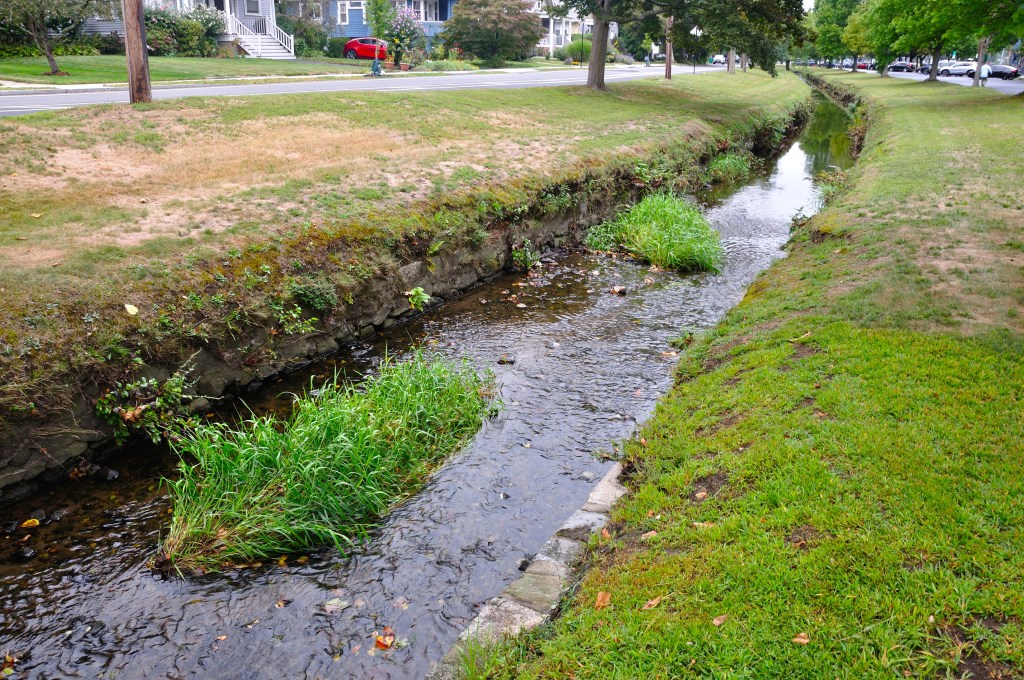
Cheesecake Brook in Albemarle Park: Fish Hiding in Plain Sight
In 2024, Native Fish Coalition (NFC) took an interest in suburban and urban streams. We wanted to know more about these heavily altered waterways and whether they did or could support wild native fish. Having grown up in Newton, I asked our Massachusetts chapter to take a look at Cold Spring Brook in Cold Spring Park.
NFC found fish in Cold Spring Park. Had we not, the whole idea may have stopped right there. We confirmed multiple age classes of golden shiners and catadromous American eels, both of which are native to the Charles River watershed. We felt that if fish persisted in one of the most degraded streams we have ever seen they could be in other Newton streams as well.
Building on what we learned at Cold Spring Brook, NFC took a look at Hammond Brook, Laundry Brook, Paul Brook, and Cheesecake Brook. NFC decided to take a closer look at Cheesecake Brook because we felt it had the most fish potential, and in several ways.
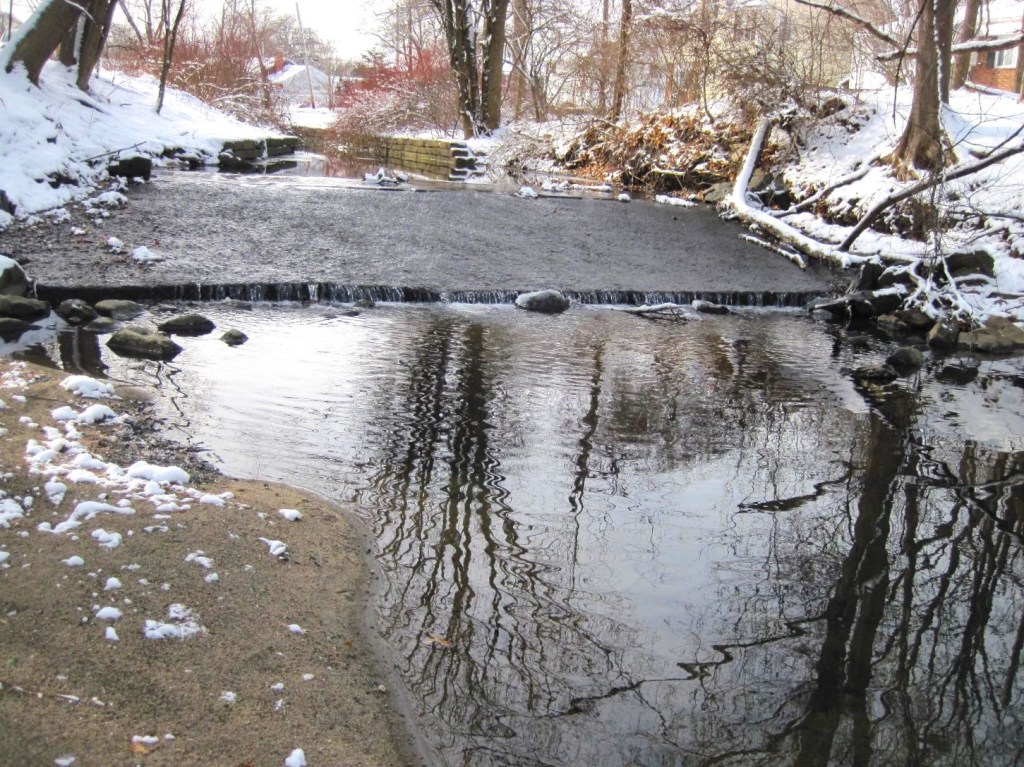
Cheesecake Brook is a direct tributary to the Charles River. The Charles River has rich fish biodiversity and biomass, including sea-run species such as alewives, blueback herring, rainbow smelt, and American shad. And while passage from the river into the brook is impeded by a sloped cement slab, the structure is not nearly as challenging as that found on Laundry Brook.
As was the case at Cold Spring Brook and other Newton streams, Cheesecake Brook was believed to be fishless. The only evidence of fish we could find was a blurred photo of what was said to be a goldfish, but may have been a carp, from Charles River Watershed Association.
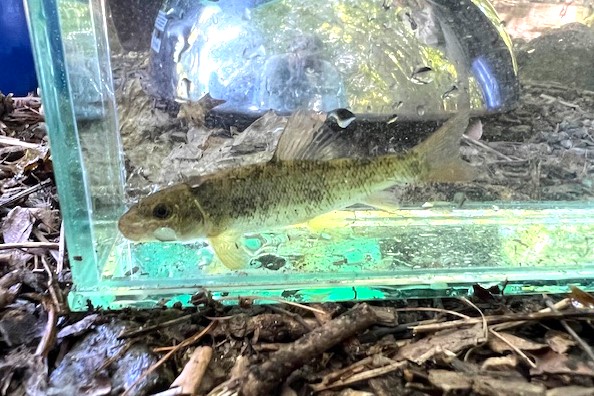
The first thing NFC did was to set a minnow trap beneath the furthest downstream bridge on Watertown Street. The next day, MA NFC board member Jeff Moore, also from Newton, called me and said he had captured a juvenile native white sucker.
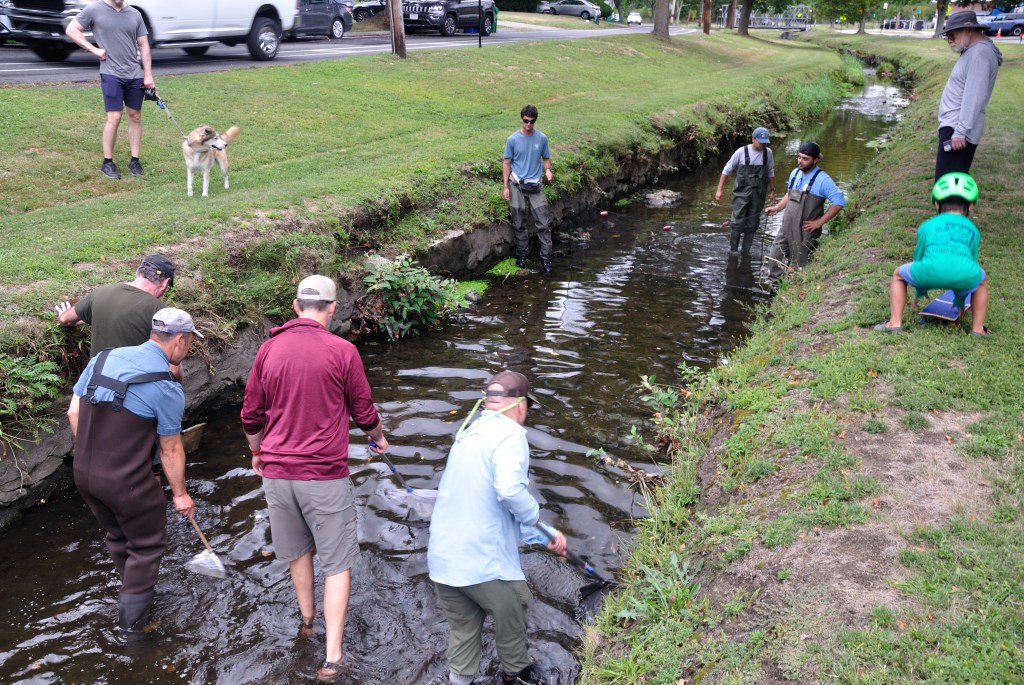
Wanting to dig in deeper, NFC turned to Adam Kautza from MassWildlife to see if he would be willing to electro-fish Cheesecake Brook. When it comes to finding fish, nothing is as effective as electro-fishing as it temporarily stuns fish and brings them to the surface where they can be collected, viewed, and released unharmed.
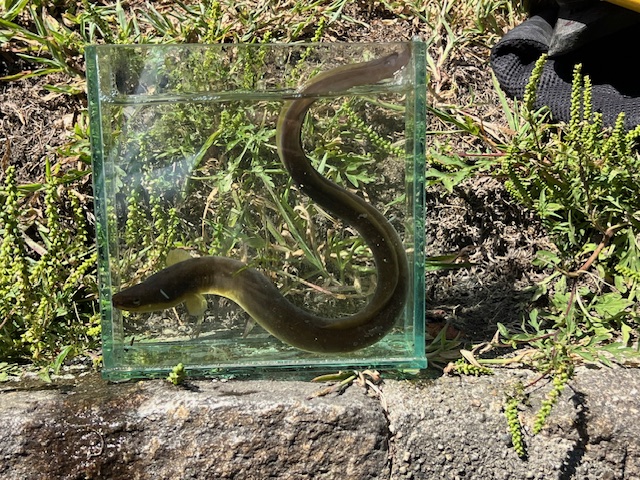
In August 2025, members of MA NFC and MassWildlife electro-fished two sections of Cheesecake Brook: Just upstream of Craft Street and just upstream of the cement slab at the Charles River. This effort resulted in the capture of 6 native white suckers, 12 nonnative carp, and six catadromous American eels, a species born in the Sargasso Sea.
Subsequent seining and trapping efforts conducted by NFC with help from Charles River Watershed Association and Friends of Cold Spring Brook yielded 2 more native white suckers, 1 additional nonnative carp, and a single native pumpkinseed sunfish, the first encountered upstream of the cement slab.
To date NFC and our partners have captured 9 native white suckers, 15 nonnative carp, 6 American eels, 1 native pumpkinseed sunfish, 1 native crayfish, and a few green frogs in Cheesecake Brook upstream of the cement slab. And we have seen countless more unidentified fish as well. Interestingly, all fish captured or seen have been juveniles.
NFC will be continuing our work on Cheesecake Brook through the 2026 season. We look to expand our fish surveys upstream of Watertown Street, as well as conducting some more surveys in Albemarle Park. NFC also looks to do some eDNA metabarcoding testing to see what other species of fish might be in the stream.
NFC would like to monitor the cement slab on Cheesecake Brook just upstream of the Charles River during the spring to see of any river herring are gaining access to the stream or trying to do so. We hope to be able to be able to solicit help from volunteers through informational signage, blogging, and articles in local newspapers.
There is still a lot of work to be done at Cheesecake Brook. This includes monitoring water temperature and dissolved oxygen, as well as testing for salination from road salting in the spring after the first rains. NFC is looking forward to working with other organizations and agencies to see what can be done to make life a bit easier for aquatic lifeforms in Cheesecake Brook.
Click here to follow our work at Cheesecake Brook. To donate to help fund our work at Cheesecake Brook click here.
About the author:
BOB MALLARD was born and raised in Newton, Massachusetts. He is a founding member and Executive Director for Native Fish Coalition. Bob has written 5 books and hundreds of articles on fly fishing, fisheries management, and native fish conservation. He can be reached at NativeFishCoalition.org or Info@NativeFishCoalition.org
 Friends of Albemarle
One thought on “Guest Post: Fish Hiding in Plain Sight”